
Children aged six to nine are packing simulated Martian soil around a sealed plastic dome when the work suddenly stops. How will their model colony recharge its batteries? Where will the water come from? What happens to waste in a closed system?
Nobody prompted these questions. The children have moved beyond making a model look convincing to asking how a whole system might work. That shift explains why schools need maker labs. A good lab does not simply teach children to use tools. It helps them recognise problems, investigate consequences and decide what is worth creating.
What is a school innovation lab?
A school innovation lab is a prepared environment where children identify needs, investigate ideas and test solutions. The starting point is not the machine but the question. A drill, a soldering iron or a 3D printer becomes useful only when a child has a reason to reach for it.
Among the options for a maker lab school Hyderabad families can visit, Blue Blocks Montessori School organises its Innovation Lab around three principles: care of tools, respect for materials and responsibility for creation. Cutting wood and connecting circuits matter. So does deciding whether a material suits its purpose, whether the prototype can be repaired and whether the finished object genuinely helps someone.
Five hundred tools, introduced with purpose
Blue Blocks describes roughly 500 tools across its developmental innovation framework from birth to eighteen, introduced as children’s coordination, judgement and responsibility grow.
For young children, pouring jugs, scissors and tweezers develop control and care. In the primary years, supervised introductions extend to hand saws, drills and soldering equipment, with safety preparation suited to each child’s readiness. Trained adolescents progress to 3D printers, laser cutters and CNC machines.
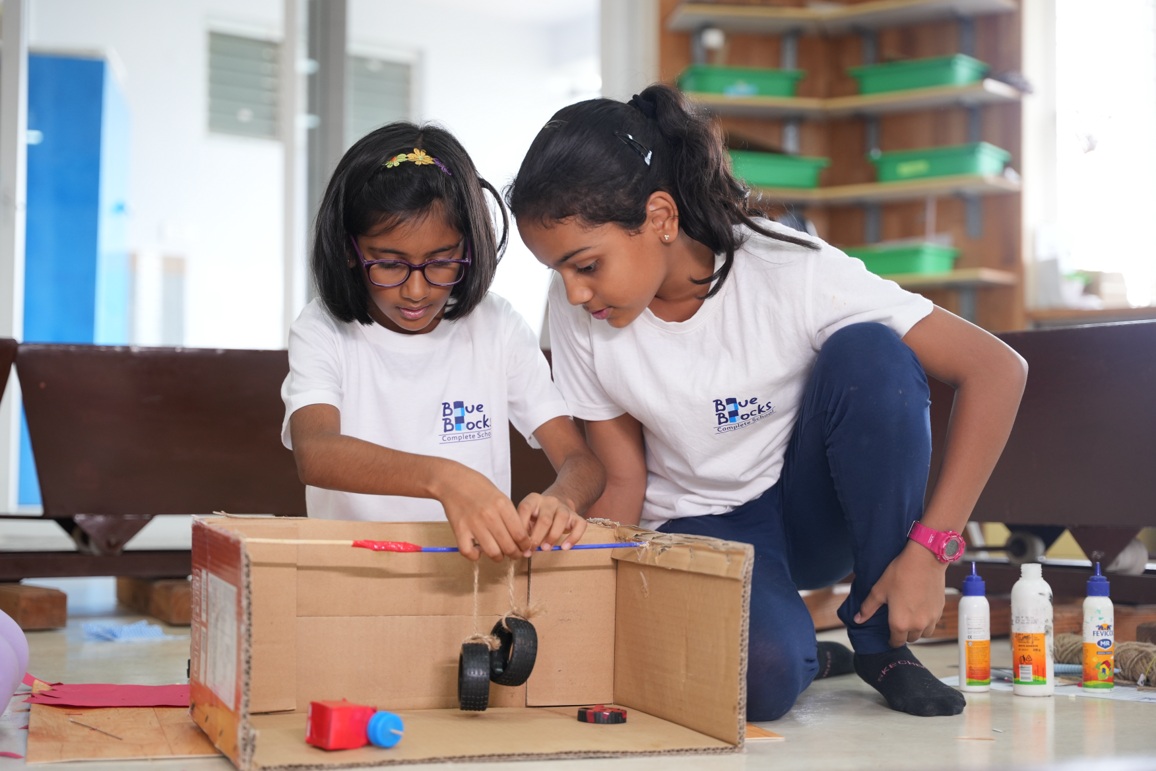
The pathway also develops the idea itself, moving from an observational sketch to a three-dimensional model, then to a prototype and finally to a working creation. Elementary investigations might involve cardboard construction, wooden bridges, and square wheels, while older students move towards mechanical and electronic systems. The important change is not only the power of the tool but the quality of judgement behind its use. Children also learn that choosing the right tool often saves time. A carefully measured cut can prevent repeated trial and error, and a simple cardboard mock-up can expose a problem before buying a single expensive component.
Care of tools and respect for materials
Tools are carried, used, maintained and returned properly, because a missing instrument can delay the next child’s work. Care is part of making, not merely the clean-up afterwards.
Materials carry their own lesson. Wood comes from trees, metal from ore and plastic largely from fossil-based resources. Measuring before cutting, using offcuts and redesigning wasteful parts teach children that matter is valuable, and constraints often invite creativity rather than limiting it.
Responsibility extends to the finished object. A useful creation may last for years, while another may become waste almost immediately. Students learn to consider repair, reuse and unintended consequences before celebrating a successful build.
When a model breaks, what does the child do next?
A bridge collapses. A wheel spins without moving the vehicle. A circuit fails. Broken models like these often reveal more than polished exhibition pieces.
Montessori’s idea of control of error suggests a response: help the child see where the design failed rather than announce the answer. Educators can notice how readily a child diagnoses the problem and attempts a revision, a reflective observation rather than a standardised measure. The failure becomes useful information instead of a judgement about the maker.
A guide might ask the student to keep both versions and explain the difference between them. That comparison shows whether the child changed the dimensions, the material, the method of construction or an underlying assumption. It makes the reasoning visible without turning every attempt into a grade.
Four questions before the first cut
Before cutting or printing, students consider four questions. Who is this for, and have we understood the person who will use it? Does it serve a genuine need? Does it heal or harm, and what unintended effects might follow? Does it regenerate or extract, and can we conserve, repair or reuse the materials?
These questions do not discourage experimentation. They invite children to reconsider an idea before consuming resources. They also bring the user into the process, because a design that seems ingenious to its maker may prove awkward or unnecessary when someone else tries to use it.
A ruler that begins with empathy
One account from Blue Blocks describes eight-year-olds noticing that ordinary ruler markings were awkward for a left-handed classmate. One child designed an alternative, and sixteen classmates went on to create their own versions.
The order of events matters: empathy came first, observation second and fabrication third. The children questioned an everyday object that worked for most of them but not for one friend. A useful invention does not need a motor or a screen. It may begin by making a familiar tool more inclusive.
Software can be made responsibly too
Software-making calls for the same judgement. At Blue Blocks, twelve adolescents aged 12 to 16 co-designed an AI “Dream Teacher”, deciding its tone and how it should respond to mistakes. A later classroom prototype used school-controlled accounts, four supervising adults and a teacher dashboard for safeguarding and learning signals.
The student-led co-design study, published by the Blue Blocks Micro Research Institute, and its follow-up report describe feasibility rather than proven learning gains. The lesson for schools is that designing software includes deciding what a system must not do, and who remains accountable when it is used.
What are innovation labs and why are they important?
Innovation labs make knowledge necessary. A model that will not balance invites an investigation into centre of gravity, and a bending bridge prompts questions about structure. Mathematics becomes a way of testing, writing a way of documenting and science a way of explaining results.
The Blue Blocks Micro Research Institute has reviewed the difference between hands-on and lecture-based learning. Wider research on active learning supports participation, although findings from older students cannot establish outcomes for every young child or every lab.
In the innovation lab school Hyderabad parents can visit at Tellapur, the Innovation Lab sits alongside biomimicry, drone and space-learning facilities. Each has its own projects and stories. This lab’s focus is designing, testing and caring for what children make.
Choosing a school: four questions worth asking
Parents weighing up any school with innovation curriculum claims can learn a great deal from four questions. Who decides what gets made? Child-generated questions reveal more than pre-packaged kits, although kits can teach useful techniques.
What happens to tools and materials? Ask about safety, maintenance, returning equipment and limiting waste.
What happens to failed prototypes? Look for diagnosis, revision and a willingness to display unfinished attempts alongside finished ones.
Does making begin early? A strong programme shows a developmental progression from safe everyday tools to complex fabrication, rather than a dependence on expensive machines.
The question behind every project
A well-equipped lab shows what children can build. A thoughtful one can also explain what they chose not to build, because it served no need or wasted too much material. The deeper lesson is not only how to make, but when making is worthwhile.
Frequently asked questions
Does a maker lab replace science lessons?
No. Making applies science, mathematics, language and design, but it does not replace them. Building a bridge makes forces and measurement relevant, yet students still need accurate concepts and time to reflect on what their results mean.
Do maker labs suit children who are not interested in technology?
Yes. Repair, woodwork, sewing, drawing and improving everyday objects are all forms of making. A child drawn to art or nature can find a way in through design or materials, and the starting point need not be coding or electronics.
How can parents encourage making at home?
Offer real materials and a place to work: cardboard, tape, string, offcuts and a few safe tools stored where the child can reach them. Ask about the problem the child is solving rather than praising the finished object, and let a broken attempt stay on the table long enough to be examined.
How can I tell what my child learnt from a project?
Ask your child to explain what changed between the first version and the last. A child who can describe why a design failed and what they changed as a result has learnt more than one who can only show the final piece.
