Author

Doris Smith

Browsing

In her third year at NYU’s Stern School of Business, Lauren Park had already mastered spreadsheets, case studies, and the art of pretending she wasn’t stressed while sipping a seven-dollar cold brew. But nothing prepared her for the moment her group’s Financial Modeling & Analysis professor emailed their grading rubric:

“Submit ONE PDF containing all charts, projections, and commentary.”

Her group had generated more than thirty separate charts: quarterly projections, revenue curves, cost structures, breakeven analyses, scenario simulations, and risk assessments. They had done the work. But all of it was scattered across Excel exports, PowerPoint slides, Google Sheets screenshots, and a few photos someone had snapped with their phone “just in case.”

Their presentation was at 9:00 AM the next morning.

When Data Isn’t the Problem—Presentation Is

Lauren knew the numbers were correct. Her group had triple-checked every formula. But professors don’t grade spreadsheets; they grade clarity. Scattered files meant charts in the wrong order, missing context, inconsistent styles, and a high chance of confusion when they were standing in front of the room trying to tell a cohesive story.

If they submitted a folder full of mismatched documents, it would send the wrong message: that the group hadn’t bothered to organize their work. In a business course built around communication and professionalism, that was almost worse than having bad numbers.

The Late-Night Struggle to Pull Everything Together

Just after midnight, sitting at a long table in Bobst Library, Lauren began trying to stitch everything together. She first dragged all the exported charts into a word processor, hoping to build a quick report. The layout collapsed almost immediately. Images resized themselves at random, page breaks chopped charts in half, and captions jumped to awkward places.

She tried a cloud-based document editor next. It stalled as soon as she uploaded the eighth chart. Then she opened a presentation file and pasted everything into slides, only to watch the file size balloon to hundreds of megabytes. Uploading something that heavy to the course portal was risky; opening it in class could turn into a technical disaster.

The group chat on her phone was silent. Everyone else had given up for the night. Lauren checked the time: 12:27 AM. She exhaled slowly and thought, not for the first time that semester:

“Okay… there has GOT to be a better way.”

Finding a Tool That Made the Whole Night Easier

Lauren opened her browser and typed https://pdfmigo.com. She had used the site earlier in the semester for a marketing packet, but tonight the stakes felt higher.

She exported each chart from Excel and her slide deck as a PDF and dropped them all into the upload area: EBIT projections, sensitivity analyses, break-even curves, burn-rate over time, revenue waterfall charts, and competitive comparison graphs. Within moments, the screen filled with neatly aligned thumbnails. For the first time that night, the project looked like a report instead of a digital junk drawer.

She rearranged the pages to mirror the story she wanted to tell in class: starting with the executive summary, moving into revenue projections, then cost breakdowns, risk models, and finally the valuation and recommendation. Once the order felt right, she clicked the button labeled Merge PDF.

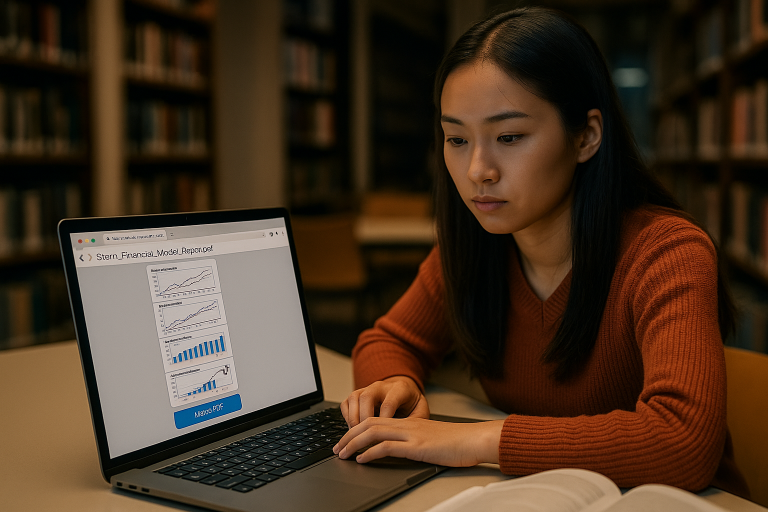
Seconds later, she downloaded a single file: Stern_Financial_Model_Report.pdf. Every chart was in place, every page aligned, and the whole document looked intentional and polished.

The Presentation That Looked Like a Consulting Deck

The next morning, Lauren’s group stood at the front of the classroom. When she opened the merged PDF on the projector, the first page showed a clean overview chart. As she advanced through the pages, the narrative flowed naturally: market context, projected growth, cost structure, risk exposure, and final valuation.

No one had to scramble between files. There were no awkward pauses while hunting for the “other version” of a chart. The professor nodded as each slide appeared. A few classmates whispered about how professional the report looked.

Afterward, their professor commented, “Your analysis was strong, but what really stood out was how clearly everything was presented. It looked like something you could show to a client tomorrow.”

Lauren knew the math mattered. But in that moment, she also understood how much presentation shapes perception. The merged PDF hadn’t changed their numbers—only the way those numbers met their audience.

Why Business Students Quietly Depend on Tools Like This

At business schools across the country, students are constantly juggling data: models, dashboards, slide decks, exported charts. Group work multiplies that complexity. By the time a project is ready, the raw material often lives in dozens of separate files.

Yet the people grading their work want something simple: one document, one story, one place to look. Tools that merge and organize PDFs bridge the gap between the messy reality of collaboration and the polished expectations of the classroom.

For Lauren, that bridge was the difference between a scattered submission and a confident, consulting-level presentation. The numbers were theirs. The clarity came from knowing how to package them.

Education today is no longer limited to textbooks and exams. Parents now look for schools that prepare children for a global future while supporting emotional, social, and creative growth. This shift in mindset has made International schools in Pune a preferred choice for modern families who want well-rounded development for their children.

With changing career paths, global exposure, and evolving learning styles, international education is gaining strong attention across Pune.

Changing Expectations of Today’s Parents

Parents today want more than academic scores. They seek learning environments that encourage curiosity, critical thinking, and confidence. Traditional schooling models often focus heavily on memorization, while modern parents prefer practical learning and global exposure.

This is one of the main reasons Pune International Schools are seeing increased demand. These schools emphasize skill-based learning that prepares students for real-world challenges rather than rote learning.

Global Curriculum With Practical Learning

One of the biggest attractions of international education is the curriculum. International schools follow globally recognized frameworks that promote understanding, creativity, and application of knowledge.

Students benefit from:

  • Concept-based learning
  • Inquiry-driven classrooms
  • Project and activity-based assessments
  • Exposure to global perspectives

This approach helps students understand concepts deeply instead of memorizing information for exams.

Focus on Overall Personality Development

Academic knowledge alone is not enough in today’s world. Communication skills, leadership qualities, and emotional intelligence are equally important. Many International cbse schools in Pune integrate life skills into everyday learning.

Students are encouraged to:

  • Speak confidently in class
  • Participate in debates and presentations
  • Work in teams
  • Take initiative and responsibility

These qualities help children grow into confident individuals who are ready to face future challenges.

Language Skills and Global Exposure

Strong communication skills are essential for success in higher education and professional life. International schools place a strong focus on language development, especially English proficiency.

Students are regularly exposed to:

  • Public speaking activities
  • Group discussions
  • Creative writing and storytelling
  • Cultural exchange programs

Such exposure helps children become fluent communicators with a global outlook, which many parents value deeply.

Smaller Class Sizes and Individual Attention

Another reason parents prefer best international schools in Pune is the student-teacher ratio. Smaller class sizes allow teachers to give personal attention to each child.

This helps in:

  • Identifying learning strengths and gaps early
  • Supporting different learning styles
  • Encouraging shy or introverted students
  • Building strong teacher-student relationships

Parents appreciate knowing that their child is not lost in a crowded classroom.

Modern Infrastructure and Learning Spaces

Learning environments matter. International schools invest heavily in modern infrastructure that supports active learning. Spacious classrooms, digital tools, science labs, art studios, and sports facilities create a balanced school experience.

Many Pune International Schools also focus on safety, hygiene, and student well-being, which reassures parents about their child’s daily environment.

Emphasis on Creativity and Critical Thinking

Creativity is no longer optional. International schools encourage students to think independently, ask questions, and explore solutions rather than follow instructions blindly.

Activities such as:

  • Art and music programs
  • Robotics and coding clubs
  • Drama and creative expression
  • Innovation projects

help children discover their interests and develop problem-solving skills from a young age.

Preparation for Global Higher Education

Parents who plan for international higher education often choose international schooling early. These schools prepare students for global universities by building strong academic foundations and essential skills.

The best international schools in Pune guide students in:

  • Academic planning
  • Profile building
  • Time management
  • Independent learning habits

This makes the transition to global education systems smoother and less stressful.

A Balanced Approach to Learning

International education focuses on balance. Academics, sports, arts, and personal development are all treated as equally important. This balanced approach helps reduce pressure and burnout among students.

Children learn to enjoy the learning process while developing discipline and responsibility at the same time.

Why Pune Is Ideal for International Education

Pune is known for its education-friendly environment, cultural diversity, and quality lifestyle. Families moving from different parts of India and abroad often prefer Pune due to its strong academic ecosystem.

The rise of International schools in Pune reflects the city’s growing reputation as a hub for modern and global education.

Final Thoughts

Education choices shape a child’s future. As parents seek schools that offer global exposure, skill development, and emotional growth, international education stands out as a strong option. With modern teaching methods, supportive environments, and future-focused learning, best international schools in Pune continue to attract parents who want their children to thrive in an ever-changing world.

Modern education continually evolves. Technology transforms classroom settings. Interactive lessons improve learning outcomes. Students engage deeply with content today. This approach offers many benefits. It boosts academic achievements significantly. Active participation proves crucial for growth. Deeper comprehension then results naturally. Traditional methods often lag behind now. Interactive tools bridge knowledge gaps. They foster real understanding quickly. Students truly thrive with this method. Learning becomes very dynamic and rich. Engagement drives better overall results.

Enhancing Memory Retention

The interactive technology lessons strengthens memory retention. Students actively participate often. Hands-on tasks build strong lasting recall. Visual aids cement new complex concepts. Digital simulations reinforce prior learning. Repetition occurs naturally through play. Mission.io tools provide engagement. Learners process information much better. They retain knowledge for longer periods. This active recall method works powerfully. It moves data to long-term memory stores. Quizzes offer instant helpful feedback. Games make learning truly fun and easy. Memory retention improves greatly now. Deeper understanding rapidly takes form. Technology makes memories stick firmly. Mission.io makes learning effective. Understanding grows with regular practice. Students remember core lessons clearly. Learning becomes very durable and strong. Retention rates climb high consistently. Content sticks in minds forever. Active engagement is essential.

Boosting Problem-Solving Skills

Interactive lessons foster strong problem-solving. Students face challenges directly. They experiment with many solutions. Virtual labs teach complex ideas. Simulations demand critical thoughtful action. Learners make real-time quick decisions. They analyze consequences quickly always. Mistakes become valuable learning chances. Adaptability grows with constant practice. Digital puzzles sharpen young minds. Students develop strategic thinking abilities. They overcome obstacles efficiently well. This approach builds great resilience. Real-world scenarios prepare students fully. Problem-solving becomes second nature quickly. These skills are vital for future success. Active involvement is key to growth. Challenges foster many new ideas. Solutions emerge from constant practice. Students learn by doing well always. Their abilities truly quickly expand. Readiness for future grows steadily. Complex issues become manageable. Decision-making improves daily.

Cognitive Advantages of Digital Learning

Digital learning offers great advantages. It personalizes learning paths well. Students progress at their own comfortable pace. Adaptive technologies respond well. Immediate feedback guides student progress. It boosts student motivation greatly. Gamification increases active engagement. Cognitive load is managed carefully now. Complex topics simplify quickly here. Digital platforms offer vast resources. Accessibility improves significantly always. Students collaborate easily online now. They connect with global peers easily. This expands their world view broadly. Digital literacy skills grow strongly. Future readiness is fully assured. Growth happens consistently for all. Engagement drives better results quickly.

Conclusion

Interactive technology truly excels. It transforms student learning rapidly. Memory improves significantly daily. Problem-solving skills grow robustly. Critical thinking deepens greatly now. Visual and hands-on methods work powerfully. Cognitive benefits are truly immense. Modern classrooms thrive with technology. Students achieve more academic success.

The SBR passing rate gets a lot of attention each sitting. It is a headline number. It can shape mood and steer choices. Yet it tells you little about your own outcome. What matters is your plan and the work you do each week. If you want straight study advice and clear checklists, you can browse these free SBR resources.

What the pass rate is – and what it is not

The SBR passing rate is a global statistic. It reflects thousands of scripts from many centres and variants. It mixes first time sitters, resit candidates, and people who sat with no real study. It includes strong scripts and blank pages. It does not tell the story of your work, your habits, or your progress.

Here is what the number does not do:

  • It does not predict your mark.
  • It does not measure the quality of your plan.
  • It does not reflect your technique.
  • It does not track your practice volume or timing.

Here is what the number can do if you let it:

  • It can raise stress.
  • It can push you to cram.
  • It can tempt you to buy more notes.
  • It can distract you from practice.

Keep the pass rate in context. Use it as background noise. Then focus on what you can control.

Focus on controllable inputs

SBR ACCA rewards clear writing, applied thinking, and time control. Those are controllable skills. You build them with short, regular tasks. You do not need long study marathons. You need steady work that trains your hand and mind. This is how to pass ACCA SBR with calm confidence.

Useful inputs you can control:

  • A weekly plan with realistic targets.
  • Daily writing practice that mirrors the exam.
  • Feedback on scripts from an ACCA tutor online or class.
  • Two or three timed mocks with debriefs.
  • A lean set of SBR notes in your own words.

When you control inputs, ACCA exam success becomes a process. You reduce guesswork. You replace anxiety with action.

What markers reward in SBR

Markers read fast. They use a scheme. They look for clear points that match the requirement. They value logic and structure. ACCA teaching often reduces this to one simple shape:

  • State the issue.
  • Explain the effect using the rule.
  • Apply the rule to the case facts.
  • Conclude with a decision.

Practice that shape until it is routine. You can do it in two to six lines per point. Use simple language. Avoid filler. Keep the verbs strong. This habit lifts marks in any SBR question, including SBR UK.

Why chasing the pass rate harms progress

When you chase a number, you tend to:

  • Read more, write less.
  • Seek new summaries, ignore feedback.
  • Panic about topics, skip practice.
  • Cram late, run out of time in the exam.

Reading notes can feel safe. But SBR is a writing exam. The mark comes from what you put on the page. ACCA SBR revision that centres on writing beats passive reading every time.

A four week plan that ignores the pass rate

Here is a simple plan you can start this week. It fits around work. It suits self study, ACCA SBR classes, and ACCA SBR online classes. It also supports those using an ACCA private tutor or an SBR group.

Week 1 – Map and reset

  • Identify three weak topics and one timing issue.
  • Build one page of SBR notes per weak topic.
  • Attempt two short, timed tasks on each topic.
  • Submit one script for marking if possible.

Week 2 – Technique and timing

  • Drill the issue – effect – case – conclusion shape each day.
  • Attempt two 25 minute scenarios to time.
  • Run a marker style checklist on each script.
  • Update notes with better phrases.

Week 3 – Full practice

  • Sit one 60 minute question midweek.
  • Sit a second 60 minute question at the weekend.
  • Debrief both scripts.
  • Rewrite one answer that left marks on the table.

Week 4 – Mock and polish

  • Sit a full mock under exam conditions.
  • Track time per requirement.
  • Fix two habits.
  • Light review of notes, then rest.

If you prefer a structured timetable with checkpoints and marking, review the current SBR course options for a route that matches your schedule.

Build lean notes that help you write

Big files do not help in the final weeks. Lean notes do. Aim for one clear page per topic. Use the same layout each time:

  • Definition – one line.
  • Recognition or measurement – two bullets.
  • Presentation and disclosure – two bullets.
  • Applied example – one or two lines tied to a case.

Update your notes after feedback. Replace vague words with precise terms. Add short phrases you can drop into an answer. This is simple SBR training that pays off.

Make timing your ally

The most common cause of lost marks is poor timing. Too much time on the first half of the paper hurts the second half. Protect time with these habits:

  • Allocate 1.8 minutes per mark and stick to it.
  • If stuck, write two clear points and move on.
  • Use short headings to keep structure tight.
  • Practise finishing every script you start.

These moves look basic. They work. ACCA tutoring that keeps you honest on time is worth it. An ACCA tutor online can review clock use and suggest simple fixes.

Use feedback to create growth

Feedback is where you turn work into gains. Ask any marker. Clear guidance on one script can raise the next script by several marks. Sources of feedback include:

  • ACCA tutors online who mark short tasks fast.
  • ACCA SBR classes that include script reviews.
  • An ACCA private tutor who sets weekly submissions.
  • A serious SBR group where you review each other’s openings.

What to look for in feedback:

  • Comments that link to the requirement.
  • Notes on what earned marks so you can repeat it.
  • A model sentence that shows a tighter way to write your point.
  • One or two priorities for the next attempt.

Choosing support without chasing hype

You do not need the biggest package in the market. You need the right support for your life. Here is a simple guide to options often seen as best sbr or sbr plus:

SBR course

  • Set path and dates.
  • Regular mocks and debriefs.
  • Good if you want structure.

SBR coaching

  • Focused help on writing and timing.
  • Weekly targets and script reviews.
  • Good if you want accountability.

ACCA tuition near me

  • In person contact.
  • Check travel time and group size.
  • Good if a classroom helps you focus.

ACCA tutor online

  • Flexible sessions.
  • Fast feedback loops.
  • Good if you need to study around shifts.

Whatever you pick, ask for a sample marked page. That tells you more than any advert.

A realistic approach for ACCA resit exams

A resit is a chance to fix specific gaps. Do not start from zero. Keep what worked. Change what did not. Try this three step approach:

  1. Diagnose with honesty
    • Read your prior feedback.
    • Note three issues that cost marks.
    • Typical issues are timing, structure, and a few weak standards.
  2. Plan short, focused work
    • Two 25 minute scripts per week.
    • One 60 minute question each weekend.
    • One rewrite of a weak answer.
  3. Seek targeted feedback
    • Use an ACCA tutor or class that marks writing.
    • Ask for two improvements per script.
    • Apply them next time.

This keeps the load light. It respects work and family. It builds the habits that drive ACCA exam success.

Practical drills that raise marks

These drills take ten to twenty minutes. Use them in any week:

  • Two sentence explain – explain a tricky rule in two lines.
  • Compare and conclude – set out two treatments and pick one.
  • Numbers to words – explain a calculation in plain English.
  • First lines only – draft the opening line for four points.
  • Rapid read – scan a case for three issues in three minutes.

These drills build clarity and speed. They suit ACCA SBR revision at all stages.

Online study – make it work for you

Online study can save hours of travel. Use that time for writing. Short sessions help you build routine. If you use ACCA tutors online, set rules for response times and marking returns. If you sit with an SBR group, keep sessions focused on answers, not debates. If you need one to one focus, an ACCA tutor or an ACCA private tutor can set a plan that fits your shifts.

If you join ACCA SBR online classes, prepare by reading the case in advance. After class, write a short summary point for your notes. Small steps keep content fresh.

Keep the variant in mind – a note on SBR UK

If you sit SBR UK, confirm your materials match the variant. Much of the writing approach is the same. You still need to answer the requirement, apply the rule, and conclude. The difference is the rules you draw on. Good ACCA teaching will flag those points as you practise.

A buyer’s checklist for support

Before you enrol with any provider or tutor, ask these questions:

  • Do you mark scripts and explain how marks are earned
  • How fast is the feedback turnaround
  • Do you run mocks and live debriefs
  • Do you teach writing moves and timing, not only theory
  • Can I see one page of sample feedback
  • Do you cover my variant, including SBR UK if needed

If the answers are clear, you are more likely to get the help you need.

A simple weekly loop to stay on track

Use this loop in any phase of study:

  • Sunday – set targets for topics, tasks, and hours.
  • Midweek – quick check on progress and blockers.
  • Friday – submit a script or sit a timed slice.
  • Saturday or Sunday – review feedback and update notes.

This loop builds accountability. It works with self study. It fits with a course or coaching. It takes focus off the SBR passing rate and puts it on work you can do today.

Final thoughts – build your outcome, ignore the noise

The pass rate is a headline. Your result will come from habits. Write often. Keep structure tight. Finish to time. Seek feedback. Adjust and repeat. If you want steady guidance and a clear path, you can explore current SBR course options. When you need quick reminders or a checklist, come back to these SBR resources and keep your plan moving.

In an era where digital transformation is redefining every industry, the need for robust cybersecurity has become more urgent than ever. From ransomware to nation-state attacks, today’s cyber threats are both sophisticated and relentless. To combat these threats, organizations around the world are investing in skilled professionals trained through cyber security online programs that offer flexibility, global recognition, and job-ready skills.

At the forefront of this educational revolution is EC Council University, a globally recognized leader in cybersecurity certification and training. Known for its flagship certifications like Certified Ethical Hacker (CEH) and Computer Hacking Forensic Investigator (CHFI), EC Council University has become the go-to institution for aspiring cybersecurity professionals, offering cyber security online programs that are both comprehensive and accessible.

Why Cyber Security Online Programs Matter Today

The cybersecurity skills gap is one of the most pressing challenges in the digital world. According to Cybersecurity Ventures, the global shortfall of cybersecurity professionals is expected to reach 3.5 million by 2025. This demand is driven by the increasing complexity of IT environments, widespread adoption of cloud computing, and the rise of remote work.

Online learning has emerged as a powerful solution to address this talent shortage. Here’s why cyber security online programs are critical:

  • Accessibility: Professionals can upskill from anywhere in the world.

  • Affordability: Online programs reduce costs associated with travel and physical materials.

  • Flexibility: Learners can study at their own pace, fitting education around work and personal commitments.

  • Scalability: Employers can train entire teams efficiently and remotely.

EC Council University has harnessed the power of online learning to build programs that are not only accessible but also rigorous and career-focused.

EC Council University: A Global Leader in Cyber Security Online Programs

EC Council University is a name synonymous with excellence in cybersecurity education. Operating in over 145 countries and having trained more than 300,000 security professionals, EC Council University offers a wide range of cyber security online programs that cover every specialization—from ethical hacking to incident response, digital forensics, and executive leadership.

Here are the core pillars that make EC Council University’s programs stand out:

1. Industry-Validated Curriculum

Every EC Council University course is developed in collaboration with cybersecurity experts and is mapped to real-world job roles. Programs are aligned with frameworks such as NIST, NICE, and DoD 8570/8140, ensuring learners gain the skills that employers demand.

2. Hands-On Virtual Labs

EC Council University’s iLabs platform provides immersive, real-world scenarios where students can practice:

  • Penetration testing

  • Malware analysis

  • Vulnerability scanning

  • Digital forensics

  • Network defense strategies

These labs simulate enterprise environments, giving learners hands-on experience that translates directly to the workplace.

3. Multiple Learning Formats

Whether you prefer self-paced, live online, or hybrid models, EC Council University’s cyber security online programs are designed to fit every lifestyle. Learners can study at their convenience while maintaining access to global mentors and peer support.

4. Globally Recognized Certifications

EC Council University certifications are trusted by top employers, government agencies, and academic institutions. Their credentials are often prerequisites for positions in defense, finance, health care, and critical infrastructure.

Top EC Council University Cyber Security Online Programs

Certified Ethical Hacker (CEH)

The CEH program is one of the most recognized certifications in cybersecurity. It teaches ethical hacking techniques, penetration testing tools, and how to think like a hacker to secure systems. CEH is ideal for:

  • Security analysts

  • Network administrators

  • IT professionals looking to transition into cybersecurity

Certified Network Defender (CND)

CND focuses on network security and defense, making it perfect for those protecting enterprise infrastructures. Topics include:

  • Risk management

  • Network traffic analysis

  • Security policy design

  • Firewall configuration

Computer Hacking Forensic Investigator (CHFI)

The CHFI certification is the gold standard for digital forensics training. It prepares professionals to investigate cybercrimes, recover lost data, and provide legally admissible evidence in court. This course is ideal for:

  • Law enforcement professionals

  • Cybercrime investigators

  • Incident response teams

(Explore more about CHFI here)

EC Council University Certified Incident Handler (ECIH)

This program equips learners to respond to and mitigate incidents such as DDoS attacks, malware outbreaks, and insider threats. ECIH is essential for professionals in:

  • Security Operations Centers (SOCs)

  • IT incident response teams

  • Cybersecurity management

Career Opportunities from Cyber Security Online Programs

Graduates of EC Council University’s online programs are in high demand. Roles that are typically unlocked include:

  • Ethical Hacker / Penetration Tester

  • Cybersecurity Analyst

  • Forensics Expert

  • Network Security Administrator

  • SOC Analyst

  • Cybersecurity Consultant

  • Security Engineer

According to Glassdoor, these roles can command salaries ranging from $90,000 to $160,000 annually, depending on region and experience. EC Council University certification acts as a launchpad, accelerating careers across industries.

How EC Council University Ensures Success in Online Learning

Online learning is only effective when paired with the right support systems. EC Council University offers a learner-centric experience with:

  • 24/7 student support

  • Access to mentors and instructors

  • Community forums for peer collaboration

  • Ongoing course updates to reflect the latest threats and tools

  • Certification exam readiness assessments

This comprehensive approach ensures high completion rates and exam success.

Why EC Council University is Trusted by Governments and Enterprises

EC Council University’s certifications are recognized by:

  • U.S. Department of Defense

  • National Security Agency (NSA)

  • Homeland Security

  • Fortune 500 companies

  • International universities and training institutes

Their programs are used not only for individual upskilling but also for enterprise-wide workforce development, making them a top choice for HR and IT leaders seeking scalable training.

The Future of Cybersecurity Training Is Online

As cyber threats become more frequent and severe, the need for scalable, effective cybersecurity training will only grow. Online learning isn’t just a convenience—it’s a necessity. EC Council University is pioneering this shift with flexible, future-ready programs that prepare students for real-world roles and responsibilities.

Whether you’re a working professional, a college graduate, or an employer looking to train your team, cyber security online programs from EC Council University offer the credibility, depth, and practical relevance you need to succeed in the digital age.

Conclusion

Cybersecurity is no longer optional—it’s foundational. And to meet the security demands of a hyper-connected world, we need professionals who are trained, certified, and constantly evolving. EC Council University’s cyber security online programs are designed to meet this need head-on.

From ethical hacking to digital forensics and incident response, EC Council University’s globally respected certifications empower individuals and organizations to secure what matters most.

Explore EC Council University’s programs today and become part of a global movement to build a safer, smarter digital future.


In an increasingly digitalized global landscape, the imperative to secure network infrastructures against data breaches, sophisticated malware intrusions, and unauthorized access has transitioned from a discretionary measure to an absolute necessity for organizational resilience. Whether you are an aspiring entrant to the cybersecurity domain or a seasoned professional seeking to augment your expertise and advance your career trajectory, the acquisition of a recognized network security professional certification is paramount. Structured online network security certification programs offer both flexibility and comprehensive depth, enabling you to master critical tools, fundamental protocols, and advanced threat prevention techniques from any geographical location. These esteemed certifications not only formally validate your specialized skills but also strategically position you for opportunities involving higher levels of responsibility and commensurate compensation. Reputable institutions such as EC-Council provide globally respected and industry-aligned curricula that effectively integrate rigorous theoretical instruction with practical, real-world laboratory exercises. As the sophistication and prevalence of cyber threats continue to evolve, maintaining current certifications ensures that your knowledge and skills remain at the forefront of the field—proactive, professionally relevant, and demonstrably proficient.

Ascend to a Network Security Professional Role: Strategically Elevating Your Career Through Targeted Certification Pathways

A robust and resilient cyber defense framework is predicated upon the expertise of highly skilled security professionals. As a certified network security professional, you will function as a critical frontline expert, entrusted with the protection of vital infrastructure against an ever-evolving spectrum of cyber threats. This demanding yet rewarding career path necessitates a comprehensive understanding of firewall technologies, sophisticated intrusion detection and prevention systems, and robust encrypted communication protocols. Through meticulously structured online security certification programs, you will gain invaluable real-time exposure to the intricacies of security breaches, comprehensive vulnerability assessment methodologies, and effective system hardening techniques. Whether you pursue a foundational certification to establish your expertise or an advanced credential to specialize in a specific domain, your acquired knowledge and skills will directly and significantly impact an organization’s overall security posture. Credentials offered by recognized authorities such as EC-Council—widely acknowledged across diverse industries—serve to enhance professional credibility and ensure the acquisition of practical, employer-ready competencies. Initiate your journey towards professional certification today and establish yourself as a vital guardian of critical digital networks.

Comprehensive Curriculum of Network Security Programs

Participants in network security programs will acquire the expertise to:

  • Proactively identify and effectively mitigate both internal and external security threats.
  • Configure and maintain secure network architectures in alignment with industry best practices.
  • Implement and manage firewall technologies and Virtual Private Network (VPN) solutions.
  • Conduct thorough risk assessments and comprehensive security audits.
  • Utilize specialized tools for network traffic monitoring and efficient incident response.

These comprehensive programs extend beyond the theoretical underpinnings of network security. Many incorporate simulated laboratory environments, providing participants with essential hands-on practice in securing virtualized infrastructures. Through exposure to realistic cyberattack scenarios, you will cultivate the practical confidence and applied skills necessary for successful certification examinations and seamless workplace integration.

Strategic Selection of Network Security Certifications

The landscape of network security certifications encompasses a range of credentials with varying levels of focus and rigor. The optimal certification pathway is contingent upon your existing experience and specific professional objectives.

  • Entry-Level Certifications: Ideally suited for individuals new to the IT field seeking foundational knowledge (e.g., CompTIA Security+).
  • Professional-Level Certifications: Tailored for experienced professionals seeking advanced, hands-on defensive skills (e.g., EC-Council’s Certified Network Defender).
  • Specialized Certification Tracks: Focused on specific roles within cybersecurity, such as penetration testing or network architecture.

The strategic selection of a network security certification should align with your long-term career aspirations within the cybersecurity domain.

The Flexibility and Efficacy of 2025 Online Security Certifications

Balancing professional responsibilities with the pursuit of advanced education can present significant challenges; however, online security certification programs offer a streamlined and flexible solution.

Key Benefits Include:

  • Flexible learning schedules that accommodate individual paces.
  • Accessibility from any internet-enabled device, irrespective of geographical location.
  • Reduced costs associated with travel and accommodation.
  • Access to comprehensive recorded sessions and interactive expert question-and-answer forums.
  • Availability of remote certification examination options.

Many certifications offered by reputable organizations such as EC-Council are now available in convenient online formats without compromising academic rigor or practical relevance, ensuring high-quality learning outcomes regardless of the participant’s location.

The Value Proposition of EC-Council Credentials in Network Security

EC-Council is a globally recognized and trusted authority in cybersecurity education, renowned for its immersive, hands-on laboratory-centric approach and comprehensive global recognition within the industry. Programs such as the Certified Network Defender (CND) are specifically designed to provide participants with actionable tactical security knowledge and robust defensive strategies. Through meticulously crafted modules covering critical areas such as malware analysis, comprehensive log management, the implementation of effective network security policies, and advanced network traffic analytics, EC-Council courses distinguish themselves by effectively integrating rigorous academic depth with practical, skill-building exercises. Graduates of EC-Council programs often demonstrate enhanced competitiveness in the job market and are demonstrably better prepared to address real-time security incidents effectively. The endorsement of EC-Council significantly enhances the credibility and value of your certification, signaling a high level of competence and capability to prospective employers worldwide.

Diverse Career Pathways Following Network Security Certification

Earning a recognized network security certification unlocks a wide array of promising career opportunities within the dynamic cybersecurity landscape. Several prominent roles include:

  • Network Security Analyst: Responsible for the continuous monitoring of network systems and the effective response to identified security threats.
  • Security Engineer: Focused on the design, implementation, and maintenance of secure network infrastructure solutions.
  • Security Operations Center (SOC) Specialist: Integral members of security operations teams, responsible for the detection, analysis, and mitigation of security attacks.
  • IT Security Consultant: Providing expert advice to businesses on risk assessment, vulnerability prevention, and the implementation of robust infrastructure security measures.

Each of these critical roles places a high value on certified professionals who can effectively combine in-depth technical expertise with strategic analytical thinking. Possessing relevant certifications, particularly those from esteemed organizations such as EC-Council, significantly enhances your professional profile, fostering trust and providing a distinct competitive advantage in the cybersecurity job market.


In the realm of mental health counseling, the journey to becoming a proficient and effective counselor is a continuous one. While foundational education provides a solid basis, further studies play a pivotal role in honing your skills and keeping you abreast of the latest developments in the field.

In this article, we will explore how pursuing further studies can prepare counselors to enhance their practice in various aspects of mental health counseling, including building rapport, mastering techniques, conducting research, and the exciting prospect of earning an online master’s degree in clinical mental health counseling.

Building rapport: the foundation of effective counseling

Rapport-building is the cornerstone of any counseling practice. It lays the groundwork for trust and open communication between counselor and client. Further studies provide counselors with valuable insights and strategies to strengthen this essential skill.

Advanced communication techniques

Delving deep into communication theories, advanced studies equip counselors with a comprehensive toolkit. They explore non-verbal cues and active listening techniques, providing the tools to create a safe and empathetic environment where clients genuinely feel heard and understood.

Cultural competency

In our increasingly diverse society, cultural sensitivity is not just valuable – it’s vital. Advanced courses delve into cultural competence, teaching counselors how to respect and seamlessly integrate various cultural perspectives into their practice. This newfound knowledge fosters a deeper connection with clients from diverse backgrounds.

Mastering counseling techniques

Beyond rapport-building, further studies provide counselors with a toolkit of advanced techniques to address the unique needs of their clients in counseling sessions. Advancements in therapeutic techniques to be used during counseling are a cornerstone of a good mental health practitioner, so it’s important to be constantly taking your skills to the next level.

Cognitive behavioral therapy (CBT)

Advanced CBT training takes counselors beyond the basics. It enables them to employ intricate cognitive restructuring techniques, making them better equipped to assist clients in challenging thought patterns and behaviors. This deep dive into CBT empowers counselors to facilitate profound transformations in their clients’ lives.

Trauma-informed care

Trauma is a complex and delicate issue. Further studies in trauma-informed care equip counselors with the expertise to help clients navigate this challenging terrain. This knowledge is invaluable in promoting healing and resilience, ensuring that counselors are equipped to guide their clients toward recovery.

Solution-focused therapy

Advanced training in solution-focused therapy gives counselors refined skills. This approach emphasizes helping clients identify and work toward solutions rather than dwelling on problems. These advanced skills enhance the efficiency of the counseling process, helping clients to achieve meaningful progress more rapidly.

Conducting research: advancing the field

Research in mental health counseling is an ever-evolving field, and further studies enable counselors to contribute meaningfully to its growth.

Evidence-based practices

Advanced programs place a strong emphasis on evidence-based practices. This emphasis provides counselors with the tools not only to understand but also to critically evaluate research. Armed with this knowledge, they can apply the latest proven methods in their work, ensuring the most effective treatment for their clients.

Research competence

Pursuing further studies allows counselors to develop their research skills. This, in turn, enables them to conduct studies, analyze data and contribute to the evolving body of knowledge in mental health counseling. They become active contributors to the field, shaping its future.

Staying current

In a rapidly evolving field, staying up to date with the latest research is essential. It ensures that counselors remain at the forefront of innovation, constantly integrating cutting-edge approaches into their practice. This commitment to ongoing learning benefits both counselors and their clients.

Pursuing further studies: the online master’s in clinical mental health counseling

One of the most accessible and flexible ways to pursue further studies in mental health counseling is by earning an online master’s in clinical mental health counseling from an accredited university such as American International College. 

Flexibility

Online programs provide a unique advantage by allowing counselors to continue working while they study. The American International College (AIC) course offers a variety of flexible enrollment options and crucially does not require campus travel. This flexibility makes further education a feasible option for those with busy schedules or existing counseling practices. It ensures that counselors can immediately apply what they learn in their professional practice.

Specialization

Many online master’s programs offer specialized tracks, allowing counselors to tailor their education to their specific interests and career goals. During the AIC program, you’ll look deeper into specialized ways of practice, with modules in counseling theories, techniques, practice and consultation. You’ll also explore the sociological study of mental health, with multicultural studies and social bases of behavior. Whether you’re passionate about working with children, veterans or individuals dealing with substance abuse, you can align your education with your aspirations.

Access to resources

Online programs often provide access to extensive libraries, research databases and virtual communities. These resources ensure that counselors have the tools and support they need to excel in their studies. In the case of AIC, you’ll have access to its extensive intranet and all of the available tools and documents. You’ll also gain access to real-life resources through the 700 practicum hours spent in clinics. It’s a virtual treasure trove of information at your fingertips, enriching your educational journey.

Accreditation

To ensure the quality and legitimacy of your education, it’s crucial to choose an online program that is accredited by reputable organizations. AIC is accredited by the New England Commission of Higher Education and offers a robust curriculum aligned with the Council for Accreditation of Counseling & Related Educational Programs. The appeal of online degrees is that they offer well-rounded, comprehensive learning that is suited for busy professionals in the field, and as such, good accreditation is a must. 

The path to better learning

In the ever-evolving field of mental health counseling, further studies are not just a means of professional development but also a commitment to excellence. They provide counselors with the knowledge and skills needed to build rapport, master counseling techniques, contribute to research and, ultimately, make a profound impact on their clients’ lives. Consider pursuing an online master’s in clinical mental health counseling to take your counseling practice to the next level. 

Lifelong learning is part of the job for healthcare professionals. More advanced clinical skills and greater medical knowledge mean they provide a consistently excellent standard of care to their patients and support their colleagues effectively. There are also benefits for ambitious practitioners who continue their education, as they can take on leadership and managerial roles that command a higher salary. However, many nurses have little spare time and would prefer not to commute extensively, both of which can be a barrier to further education.

Career advancement that fits around a nurse’s life

Working nurses already managing a successful career with a busy home life often find that online learning is a logical choice. At Rockhurst University, the online post masters FNP programs 

offer clinicians the chance to earn an additional master’s degree in just fifteen months through remote learning. The coursework is completed online with one on-campus immersion, but students can still benefit from a local clinical placement, which allows them to expand their scope of practice.

In the last ten years, the growth of online educational services and the impact of COVID-19 have led to a huge surge in the popularity of remote learning. At one point, it could have been considered a niche trend, but now these accessible courses have been brought into the mainstream. From the additional convenience to the lower price point and the chance to connect with others on social forums, the benefits of online learning are so apparent that many people now prefer this option to a traditional university environment.

Nurses planning to advance their careers, but want their studies to have a minimal impact on their work and life, will find online education a great solution. Here is a closer look at why online programs work so well for nurses and what new students have to gain from this innovative way of learning.

Are online qualifications as valuable as traditional versions?

Yes, a degree or master’s earned online is considered as prestigious as a qualification from a physical university. Employers know that many nurses want to build on their skills and knowledge and enhance their career prospects but cannot commit to full-time study. Furthermore, courses are delivered by experienced professionals who are often working clinicians, as well as faculty members. Their expertise, combined with recent technological innovations, greatly enhances the learning experience in an online classroom.

Choosing online study does not mean students miss out on linking up with others, speaking to their tutor, or forming a meaningful cohort network. Throughout the educational journey, students are supported through a range of services supplied by the university. They will have access to online forums and groups to discuss their feelings about the course and share views on the topics being studied. Educators will deliver detailed feedback on their students’ assignments and help them develop their clinical skills even further. Remote learners can expect to be given the assistance they need to reach their full potential and achieve any career goals they have in mind.

How does an online nursing degree work?

Bearing in mind the practical nature of nursing, many people wonder how they can advance their skills online. Although the core of remote nursing programs, including the coursework, the assignments, and some assessments, are managed online, most have clinical practice requirements. That means nurses spend time in a clinic, a hospital near their home, or even a different department in their current workplace. Moreover, online nursing programs use new sophisticated techniques to deliver lessons and course materials. Through visualization methods, video conferencing, and AI, this form of learning is made even more successful.

The cost of online study is lower

Research has shown that online education is substantially cheaper for students than the traditional route. Nurses will always consider the financial implications of a course very seriously, and it is a huge determiner when it comes to choosing a university. Online institutions need to spend less on facilities, in terms of heating, air conditioning and maintaining physical spaces. Moreover, they do not need a crew of support staff to run the building or administrative personnel, as paperwork is processed online through the university’s automated system.

Therefore, these significant savings can be passed on to students who earn an equally valuable degree for far less. Along with more affordable tuition fees, learning off-campus has other financial benefits. As they study at home, students do not have to move to a new town and will not need to consider additional living expenses. They can also minimize their travel expenses, as they do not need to catch a bus or drive to attend a class in person. Learning materials and books are another area of remote study that offers savings because the majority of books, journals, and papers can be obtained in PDF form from an online university.

Programs are flexible and adapt to student’s needs

Combining personal responsibilities with professional commitments can leave nurses with unexpectedly hectic periods in their life. That is why many prefer an online course of study. Most remote courses have more flexibility regarding which modules can be studied, where clinical placements are located, and the timings of synchronous sessions. People searching for a course should also check that the module electives they need will always be available and that the weekly study hours can be adapted to suit their changing needs.

Additionally, online universities can also offer more flexibility when it comes to the duration of a program. Before enrolling, it is a good idea to check if this is an option, especially for nurses who may need to extend their study timeline because something has come up at home or work.

Learning is self-paced

The ability to learn at an individual pace, without the stress of keeping up with the rest of the class, is one of online learning’s biggest advantages. Online lectures can be viewed as many times as a student needs to see them, making life easier for people who struggle to take notes and those who prefer to process information over longer periods of time. Moreover, when students have difficulty with a specific topic, they can rewatch learning materials until they feel confident in their knowledge level. On a virtual learning course, students work through lessons and conduct research at a pace that suits their skills and existing competencies. They can move on to the next unit or lecture when happy to.

Study can be scheduled at a convenient time

Nurses are used to working shifts which can leave them wide awake and ready for learning at unusual times. A key benefit of online study is that it offers the opportunity to create a custom learning schedule. Early mornings before the start of a shift, lunch times, and late nights can all be good study times if that is how a nurse wants it to be. There are no restrictions and no requirement to be present at a certain time of day. Therefore, study times can be organized around what works best for the student, and with no commute to campus, there is even more time to devote to learning.

Students learn to manage their time effectively

Nurses are already skilled in time management, but online learning gives them a chance to become even more motivated. To fit everything in, they need to create a schedule that gives them enough time to learn effectively, stay on top of their monthly workload and meet the deadlines their tutor sets. Refining this skill makes them more proficient in dealing with schedule conflicts and adapting to last-minute challenges.

Virtual collaborations become the norm

For nurses in a modern medical environment, virtual collaborations are commonplace. They are part of the many technological innovations that are changing how nurses work, increasing efficiency, and improving the health outcomes for patients. Online study gives students experiences of virtual discussions and communication through forums and remote tutorials. Learning in a virtual setting with other people readies students for effective remote collaborations in the workplace. They develop their ability to work as part of a team, use advanced communication practices and can learn the skills needed to lead. From responding respectfully to the views of their fellow students in discussions to becoming more confident in sharing their ideas, online students can explore a great training ground for the senior positions they will later occupy.

Improved critical thinking skills

Researchers are confident that there is a link between online study and the development of enhanced critical thinking. There are several reasons why students who learn remotely are more stimulated when developing this skill. Primarily, the nature of a virtual environment differs from that of a classroom, in which a tutor provides students with the information and resources they need. Online there is an additional element of challenge because students often have to overcome obstacles, such as balancing their home, work, and learning commitments. Furthermore, because they are potentially learning with people from a wider geographical area, online students are exposed to a broader range of viewpoints and experiences. This grows their knowledge bank and means they are more capable of recognizing alternative perspectives in the future, as well as personal confirmation bias.

A student’s technological proficiency is refined

For nurses, technological skills are a key asset, and understanding the latest advances means they can perform well at work. They are often expected to interact with bedside point-of-care devices, as well as smart monitors and automated IVs. As part of a remote learning experience, students gradually improve their understanding of digital technology and online documentation to become more adept at using these innovations at work. Along with gaining better computer literacy skills, they become confident in managing their digital output and maintaining a high level of productivity. Back on the ward, this benefits nurses who need to document a patient’s progress, search for medical information, or access data from a person’s electronic health records.

Keeping track of learning materials is simple

In a paper format, storing, organizing, and retrieving information can be difficult. However, online study encourages students to use digital methods of notetaking and research, and these materials are simpler to access when needed. Annotating webpages, PDFs, and other documents is as easy as highlighting sections of text with a pen when students learn how. Moreover, most public research information can be downloaded in a different format or reformatted so it is compatible with a student’s other module materials.

Even if students prefer to take handwritten notes while listening to a lecture or carrying out research, they can save these electronically or use their phones to read and collate the data into a digital document. By having their own database of learning resources, students will find storing and organizing their course materials simpler. They can track where everything is and find what they need within a couple of clicks, so they can focus on qualifying rather than hunting around for that one page of essential notes.  

Learning at home is often more comfortable

Students can learn in bed, on the sofa, or at the dining room table if that is where they can take in most information. The ability to design and create an individual learning environment is a key draw for many who eventually choose an online route. As well as avoiding the need to travel, students do not need to sit in a packed classroom, and for many, this enables them to concentrate more fully. At home, studying can be done at quiet times, before anyone gets up in the morning, or late at night when the house is calm. Students can find the time of day that they feel most productive and then base their schedule around that. As it is delivered online, the course can even come along for vacations and breaks, so students never miss an important announcement, lecture, or discussion.

All personality types can find a way to participate 

Not everybody feels confident when speaking to a large group of people. A traditional classroom can make active participation a challenge and leave some people taking control of the discussion. In a virtual context, this is less of an issue because people can join in the debate from behind a screen which can feel less daunting. Additionally, students who are more reserved in social situations could turn to discussion boards, messaging groups, or video calls to add their input and express their views.

Resources are always accessible 

Students should always browse the digital resources offered by an online university before signing up for a program. Access to course materials and student services should be simple, with plenty of career advice, a full library, and a friendly faculty. Although remote students must work on their own initiative, the materials they are provided with must be engaging and suitable for the program. Good universities invest heavily in providing a wide range of learning resources that appeal to the learning style of every student. Furthermore, many include alternative resources, such as audiobooks and podcasts, in the study program. Students can seek out the various materials from wherever they are and at any time. So, if they are struggling to commit a certain idea to memory, additional help is always on hand.

Students can link up with a wide network of other nurses

Post-graduate degrees offer students the chance to meet people with the same experiences and professional goals. Networking is one of the most beneficial aspects of continued study. By choosing an online qualification, students enjoy the same opportunities to meet others and become part of a healthcare community. The best universities prioritize peer-to-peer interaction with virtual study sessions, group work, and collaborations which are useful to a nurse’s professional development. This network of people will move into their senior positions at a similar time, so they can continue to support each other throughout their careers. They can share news about new openings at their facility, interesting research opportunities, and more. In this way, the network students gain during an online program can play a vital part in their future careers.

Choosing an online route for nursing degrees

Nurses considering an online degree program, should think about how this type of study will fit in with their daily life. It can be a good solution for anyone who wants an affordable education but also needs to balance the demands of work and family. Moreover, remote study demonstrates mastery of many essential nursing skills, from time management to critical thinking and self-motivation. As such, it is an effective method of professional development that paves the way for better job satisfaction, a higher salary, and careers in advanced nursing.

Almost everyone has had a dream of flying. A job in aviation seems like a lot of fun. But it’s hard to learn how to work in the aviation industry. The cost of education is much more than just those two things. When choosing a flying school, you should think about your needs, goals, money, and time. Before you choose a school, you should do your research. Let’s look at some of the things you should think about when picking from several flight schools.

Goal-Set 

Don’t start by comparing the prices of different flight schools right away. Where do you plan to go to learn how to fly? Do you want to learn to fly as a hobby or as a job? If you could fly, what would it be like? Before you start flight school, it’s a good idea to learn more about the airline business. If you change your mind in the middle of the process, it could cost you money.

Cost-Effective Flying School 

How much flight school costs depends on what services you want. Find out what kind of plane you want to learn to fly so you can get an idea of how much money you’ll need. If you’re on the fence about investing in pilot training, check out how much other well-known schools charge for similar programs. Then it’s time to look for colleges that fit your budget.

Cost isn’t the only thing you should think about. Due to how hard it is to learn to fly and how important it is to have skilled teachers and thorough lessons, the cheapest lessons aren’t always the best choice. The amount of pay depends on the situation. You can pay all at once or set up payments every month. Find out what the flying school’s policy is on refunds. If you can’t take your classes because of an emergency, you should be able to get your money back.

Scheduling 

“How long do you have?” is the question. Training to work for an airline takes time and money, and some rules have to be followed. It’s up to you how you divide your time between flying lessons. Small amounts of time and effort slow down progress. In other words, if you want to learn how to fly, you may have to spend more time and money on it. This should be your top priority. 

People need to be taught. When there are long breaks between classes, time is not used well. To learn to fly, you have to meet certain requirements and follow a course plan. Before you apply to a college, make sure you can check off all the boxes on their list of requirements.

Investigate 

It is very important to choose the right flying school. You shouldn’t let distance or cost stop you from looking into possible flying schools. If you want a good school, choose one that has been around for a while and has teachers who have been there for a long time. Make sure that your school has the planes, simulators, and classroom space needed to teach ATPL Integrated. When you go to a flight school, look out for the following:

  • Planes that are well-kept and have everything they need
  • The best number of teachers to students is one for every four or five students.
  • There are meetings before and after class (this is important)
  • Space and conveniences that go above and beyond